Technological Education Resources Technological Education Resources Tech Edu
  • Educator Resources
    • General Slides
    • General Materials
    • General Design & Fabrication
    • Computer Engineering Notes
  • Classes
    • TAS Slides
    • TEJ Slides
    • TTJ / TTS Slides
  • Glossary
  • Lore
  • About
  1. 2. S.O. N.I.C.E. Design Process
  • General Design & Fabrication Home
  • 1. Culture and Land-Based Learning
    • 1. Grandmother Moon, Seasons, and Turtle’s Back
    • 2. Land Lettermark
  • 2. S.O. N.I.C.E. Design Process
    • 1. Understand the Situation & Opportunity
    • 2. Record User Needs
    • 3. Necessities and Nice-to-Haves
    • 4. Rank Priorities
    • 5. Investigate and Inquire
    • 6. Create and Communicate
    • 7. Evaluate and Repeat
  • 3. Emotions and Visual Communication
    • 1. Fear and Anxiety
    • 2. Anger
    • 3. Disgust
    • 4. Envy
    • 5. Jealousy
    • 6. Guilt
    • 7. Shame
    • 8. Happiness
    • 9. Love
    • 10. Sadness
  • 4. Logo Design in Photopea
    • 1. Build the Nameplate Text
    • 2. Warm-Up: Trace the AA Logo
    • 3. Trace a Multi-Layer Logo
    • 4. Combine Logo and Nameplate
    • 5. Design Your Own Name Tag
  • 5. Logo Animation
    • 1. Bring Your Brand to Life: Animate Your Logo
  • 6. Accessible Design
    • 1. Access and Alt Text
    • 2. Fonts and Text Effects
    • 3. Understanding Colour
    • 4. Contrast and Output
  • 7. Laser Cutting and Fabrication Tools
    • 1. Make It Stand
    • 2. Measure and Place
    • 3. Material Fit and Calibration
    • 4. Assemblies and Hybrid Fabrication
    • 5. Laser-Cut Assembly, Adhesives & Finishing
    • 6. Wall and Bench Tool Module
    • 7. Design and Fabrication Capstone
  • 8. Making the Phone Holder
    • 1. Choose Your Phone Holder
    • 2. CAD You Need
    • 3. Tools and Machines
    • 4. Build Steps
  • 9. Advanced Making: Stamp or Faux-Enamel Jewellery
    • 1. Mission 2: Logo Stamp
    • 2. Tinkercad Logo Stamp
    • 3. Onshape Logo Stamp
    • 4. Mission 3: Tinkercad Faux-Enamel Brooch
    • 5. Onshape Faux-Enamel Jewellery
  • CAD Tools
    • Fabrication Plate Builder
    • Laser-Cut Leg & Support Builder
    • Tool Organizer Gallery
  • Laser-Cutting Files and Resources

S.O. N.I.C.E. Design Process

A visual table of contents for the S.O. N.I.C.E. human-centred design process.

S.O. N.I.C.E. begins by understanding the situation and spotting an opportunity to improve it. Then it keeps the user and the evidence in view from needs through the next version.
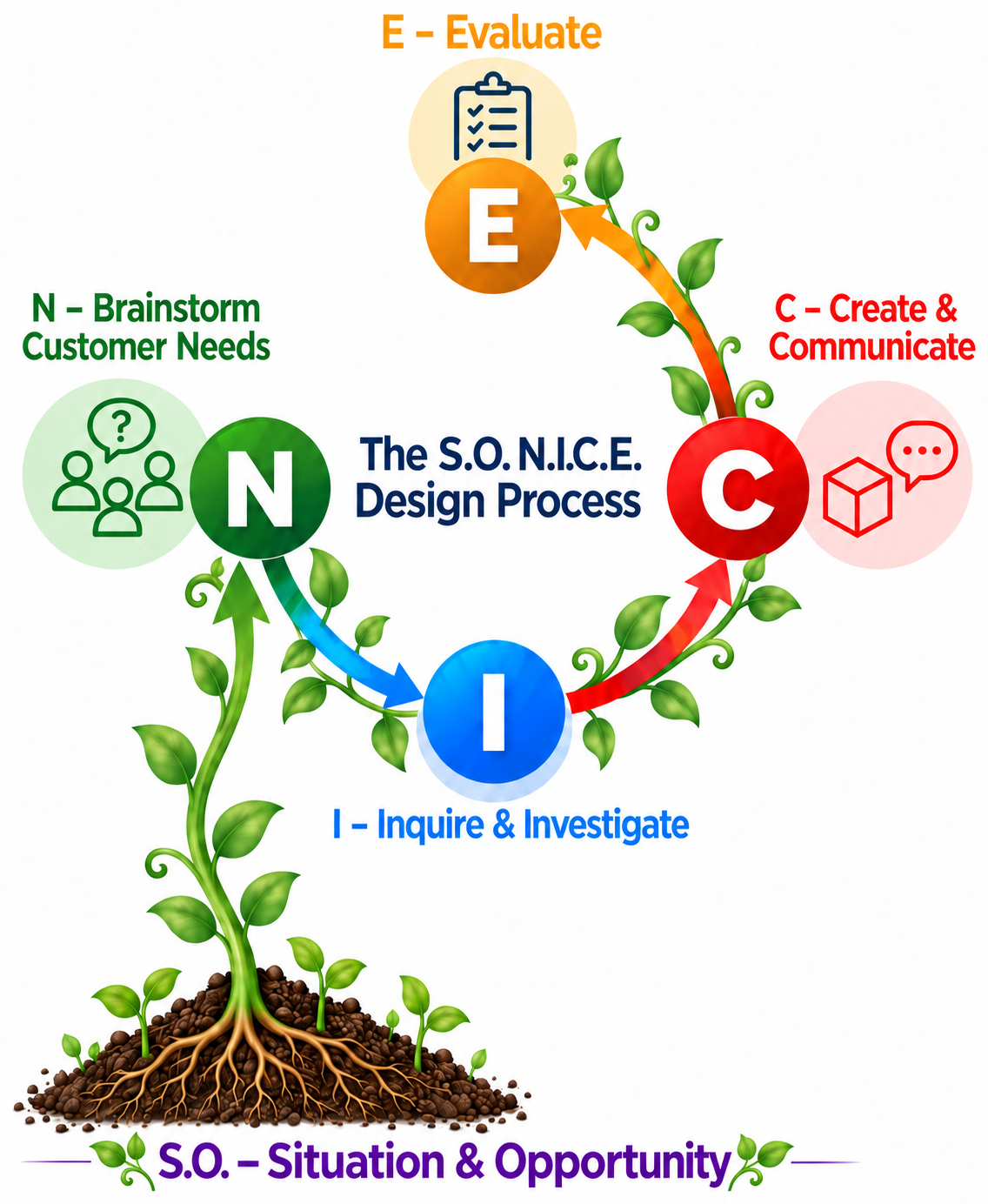
A plant grows from Situation and Opportunity at its roots into a repeating N.I.C.E. cycle: Needs, Inquiry and Investigation, Create and Communicate, and Evaluate.
Figure 1: The S.O. N.I.C.E. plant cycle grows from a situation and opportunity through Needs, Inquiry and Investigation, Create and Communicate, and Evaluate before repeating.
Search and filter lessons

Showing 7 lessons.

2. S.O. N.I.C.E. Design Process7 lessons
1. Understand the Situation & Opportunity▾

Separate facts, assumptions, and interpretations, then identify an opportunity to improve the situation.

A clear situation and opportunity keep the team focused on a meaningful improvement.

Worksheet

2. Record User Needs▾

Observe and record what people actually need in the setting.

Evidence about users guides safer and more useful designs.

Worksheet

3. Necessities and Nice-to-Haves▾

Separate non-negotiable constraints from preferences.

The distinction keeps safety and function visible when trade-offs appear.

Worksheet

4. Rank Priorities▾

Rank preferences so the most valuable improvements stay visible.

Priorities help a team compare ideas without treating every wish as equal.

Worksheet

5. Investigate and Inquire▾

Research, observe, measure, collect precedents, and generate several ideas.

Investigation replaces guesses with evidence and expands the possible solutions.

Worksheet

6. Create and Communicate▾

Develop an idea, make the proposal understandable, pitch it, and collect feedback.

Clear communication lets other people test, question, and improve a proposal.

Worksheet

7. Evaluate and Repeat▾

Score ideas against necessities and priorities, then revise the strongest option.

Evaluation turns feedback and test results into defensible improvements.

Worksheet

No lessons match these filters.

Class materials

  • S.O. N.I.C.E. Design Process slides
  • N.I.C.E. Needs Worksheet
  • N.I.C.E. Inquiry Worksheet
  • Communicate Worksheet and print version
  • Feedback Package and Plan Feedback
  • N.I.C.E. Evaluate Worksheet and N.I.C.E. Design Log
  • Videos: Kid Engineer: Bike Trailer and Pitch the Idea
  • All worksheets, examples, and classroom materials

Website code: AGPL 3.0. Educational content: CC BY-SA 4.0.

Educational content may be shared, copied, modified, and redistributed. Keep the CC BY-SA 4.0 licence and credit Andrew Andrade, andrewandrade.ca, and github.com/mrandrewandrade. Add your own name and links when adapting it. Sharing is caring.

The website code uses the AGPL 3.0, a copyleft licence: if you share modified code or run a modified version as a network service, you must make the corresponding source code available under the same licence.

 
  • References

  • Licensing