Capacitors 1: Capacitors from Zero
This is the first lesson in the capacitor sequence. Start here even if the hardware is not available.
- Monday, Lab 225: Open the capacitor slides. Start at slide 1, play the videos when they appear, and continue through slide 19. Then complete Parts 1 to 4 of the capacitor notebook. Submit the notebook by Tuesday at 7:00 PM.
- Tuesday, Portable 1: Complete both pages of the capacitor graph handout. Small groups rotate to the component table to meter-check and sort resistors and capacitors. Submit clear photos of both pages by Wednesday at 7:00 PM.
- Wednesday, Lab 225: Open the RC data and functions notebook. Calculate the time constant, plot Tuesday’s measurements as dots, define the charging and discharging functions, draw the smooth curves, and use capacitor voltage to predict a fading LED’s current.
- Thursday, Portable 1: Continue sorting components and complete the Stage 1 calculation and paper wiring plan. No powered build.
- Friday, Lab 220: Begin Stage 1: LED, resistor, and pushbutton in Tinkercad. Submit the link and screenshot by Sunday, November 22 at 7:00 PM. Monday, November 23 is the lab correction day. Physical building begins only after the simulation earns 100%.
What you will learn
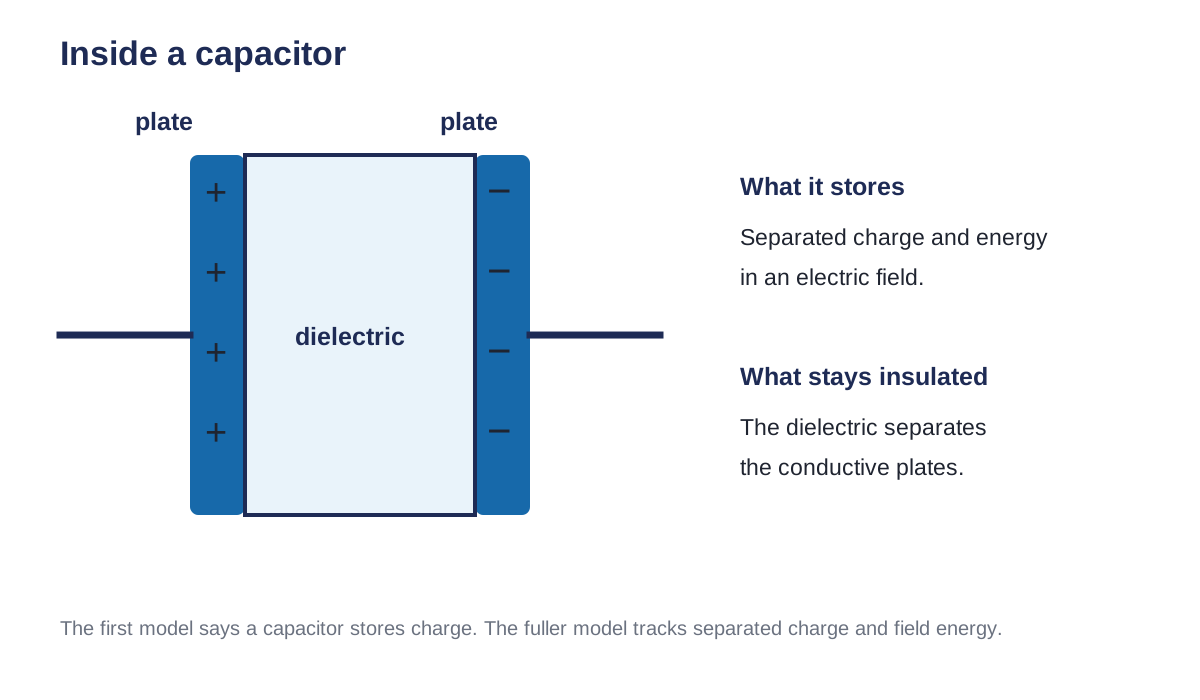
- A capacitor has two conductors separated by an insulating dielectric.
- Capacitance is measured in farads.
- Many capacitors use microfarads, nanofarads, or picofarads.
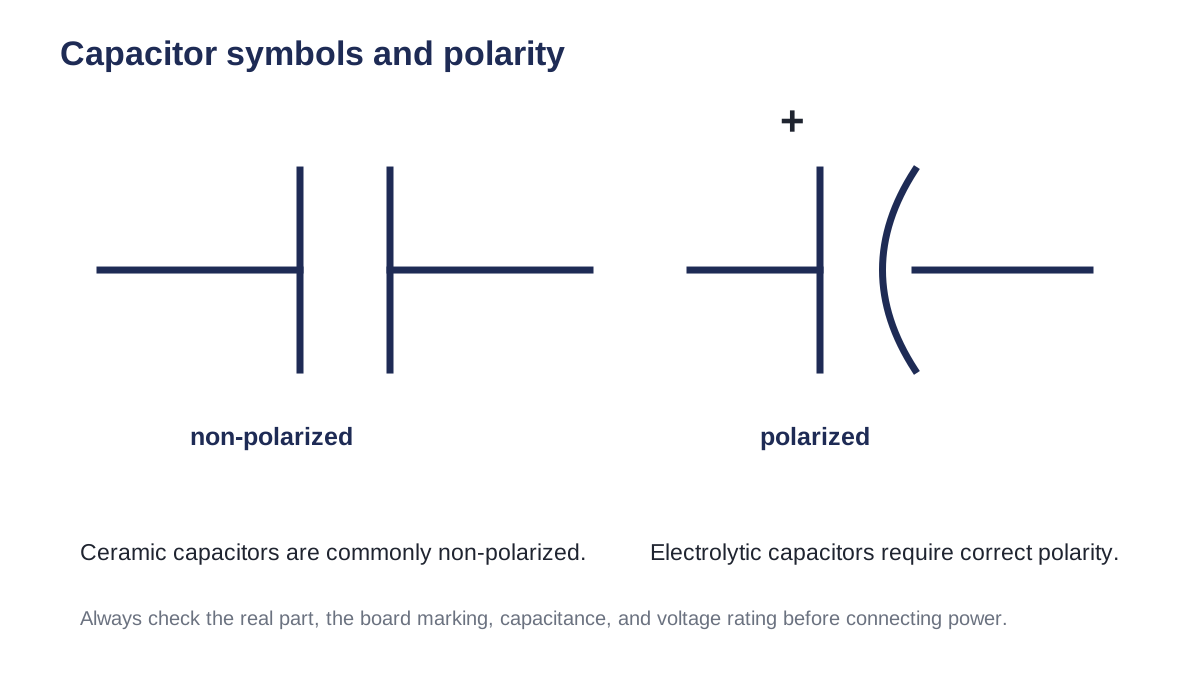
- A polarized capacitor must be connected the correct way.
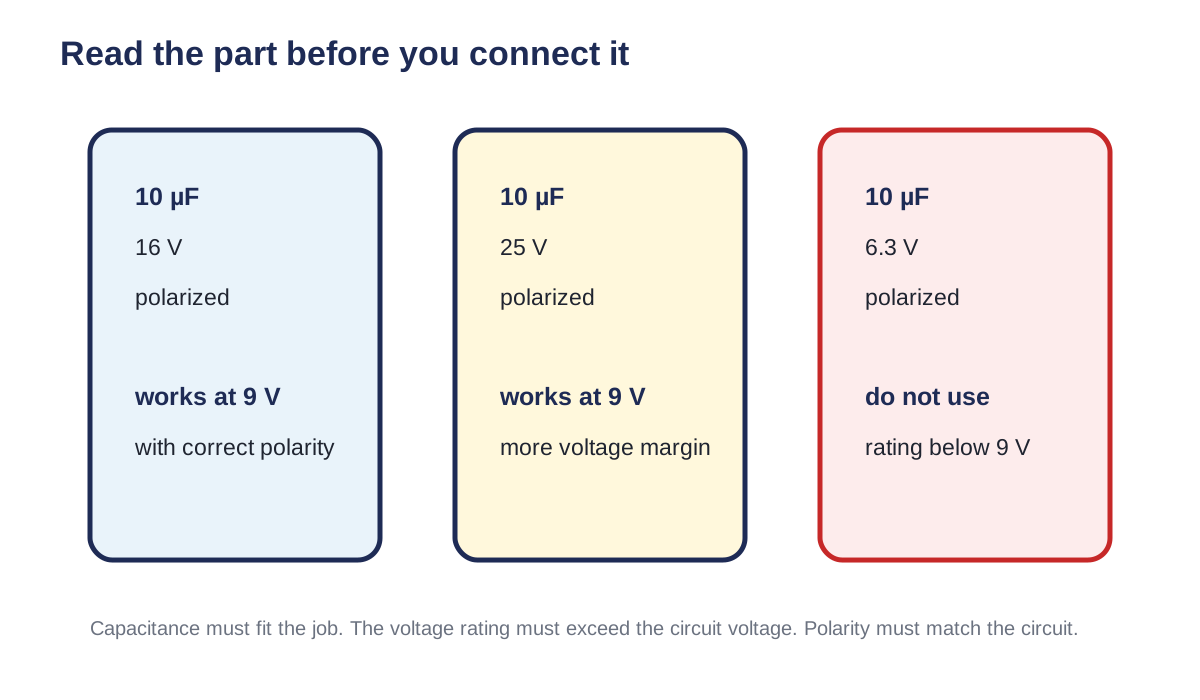
- The voltage rating must be greater than the circuit voltage.
Look inside a capacitor
Symbols and polarity
Units
\[ 1\,\mathrm{F}=10^6\,\mu\mathrm{F},\qquad 1\,\mu\mathrm{F}=10^3\,\mathrm{nF},\qquad 1\,\mathrm{nF}=10^3\,\mathrm{pF} \]
Example:
\[ 220\,\mathrm{nF}\left(\frac{1\,\mu\mathrm{F}}{1000\,\mathrm{nF}}\right)=0.220\,\mu\mathrm{F} \]
The unit you do not want cancels.
Read the part before connecting it
Charge and energy
The charge stored by an ideal capacitor is:
\[ Q=CV \]
The stored energy is:
\[ E=\frac{CV^2}{2} \]
Use farads for \(C\), volts for \(V\), coulombs for \(Q\), and joules for \(E\).
Disconnect power, discharge through a suitable resistor, and verify the voltage before handling a capacitor. Do not short a charged capacitor with a screwdriver.
Worked example using GUESS
A \(68\,\mu\mathrm{F}\) capacitor is charged to \(9.0\,\mathrm{V}\). Find the stored charge.
Given
\[C=68\times10^{-6}\,\mathrm{F},\qquad V=9.0\,\mathrm{V}\]
Unknown
\[Q=?\]
Equation
\[Q=CV\]
Substitute and solve
\[ Q=(68\times10^{-6}\,\mathrm{F})(9.0\,\mathrm{V}) =612\times10^{-6}\,\mathrm{C} \]
Statement
The capacitor stores \(612\,\mu\mathrm{C}\) of charge.
Complete the work
- Watch ElectroBOOM101-006: Capacitors and the short calculation sections in The Organic Chemistry Tutor capacitor lesson.
- Complete the five-question sheet.
- Run the notebook and use it to check the arithmetic.
- Submit the question sheet and the completed
.ipynbfile.
If the direct notebook link does not open, download the notebook, open JupyterLite, click Upload Files, and double-click the notebook.
Textbook support: Grob, Chapter 16, sections 16-1 to 16-4, pp. 484-515. Practice support: Problems Manual, Chapter 16, pp. 238-250. Optional teacher-approved lab: Experiment 16-1. [1, Ch. 16]
Equation and diagram source files
Next lesson
Continue to RC Charging and Discharging.
Help improve this lesson
If a direction, diagram, or code cell is unclear, identify the exact step. Explain what you tried and what happened. A specific report can improve the lesson for everyone.