N.I.C.E. Design
Redesigning the Design Process
Why I wanted a simpler design process for technology education, and why evaluation should send us back to the needs.
Before teaching at Port Credit, I was walking through a park along the Mississauga lakeshore in January and wondering how I was going to teach technological design well. Mechatronics had made me comfortable with mechanical, electrical, controls, and robotics design. Wood, aesthetics, material expression, and craft were less familiar territory.
There is also a small joke built into the name. After enough iteration, testing, and user feedback, the response you hope to hear is: “Nice design.”
Looking at the trees, I started thinking about wood as a material with its own properties and history. More importantly, I started thinking about design as a natural cycle rather than a straight sequence.
Too many boxes
The design-process models I knew were useful, but they were difficult to hold in your head while actually building something. The older Ontario technological education process made iteration explicit. TeachEngineering uses Ask, Research, Imagine, Plan, Create, Test, Improve, then repeat. SPICE compresses the work into Situation, Problem, Ideas and Investigation, Choose and Construct, and Evaluation.

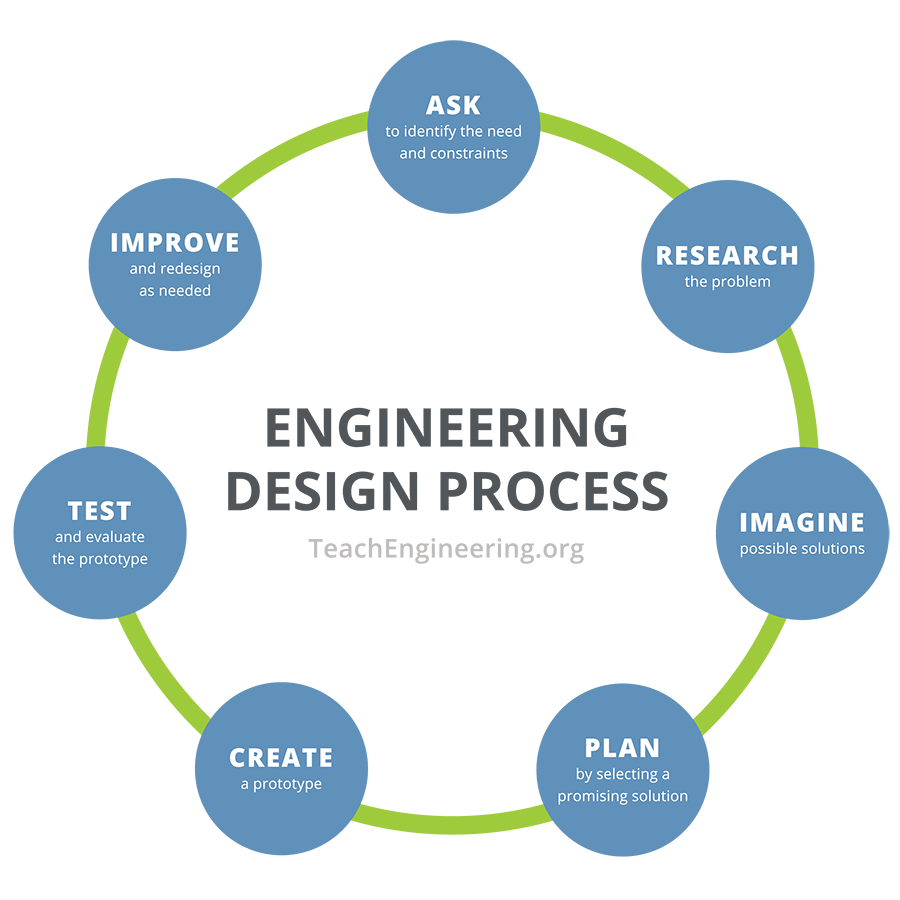
Mr. Elsie’s technology education page also brings the Ontario process and SPICE together in one place. The SPICE model shown there was created by Mr. Franzen: SPICE Design Flow Chart.
N.I.C.E.
I wanted something simple enough to remember at a workbench:
- N - Needs and Necessities
- I - Investigate and Inquire
- C - Create and Communicate
- E - Evaluate
The important move is E back to N.
An MVP or prototype gives us something real to test. Evaluation asks whether the solution met the needs, but it should also ask whether we understood the needs correctly in the first place. Users may reveal priorities they could not describe before seeing or using a solution. The best inventions sometimes expose needs people did not yet know how to name.
A spiral, not a circle
I do not picture N.I.C.E. Design as a flat loop. I picture it rising as it repeats. At the bottom, the problem is broad and poorly defined. Each cycle adds evidence, user feedback, failures, and better questions. The spiral becomes tighter as it rises, like the shape of a coniferous tree.
N.I.C.E. SPIRAL DIAGRAM PLACEHOLDER
Show N -> I -> C -> E -> N climbing upward in repeated loops. The lower loops are broad and uncertain. The upper loops become tighter and better defined, forming the profile of a coniferous tree.
N.I.C.E. Design is not meant to remove the complexity of design. It is meant to give that complexity a four-letter structure students can remember while they are doing the work.